



Given the short duration of the upcoming legislative session and the provincial election to follow, a government plan to introduce a scant two-paragraph bill granting it powers to fundamentally alter the course of forestry in B.C. is disturbing, to say the least. According to several sources who...
British Columbia's public dispute on Sustainable Forest Management
Are British Columbia's forests well managed?
by Anthony Britneff, 2011
|
|
... |
How to solve public disputes on forests?
|
In British Columbia, a dispute continues over just how sustainably managed are British Columbia’s publicly owned forests covering some 55 million hectares of the province, which is 94 million hectares in size.
At the heart of this dispute is the extent of productive forestland disturbed by wildfires, wind, diseases and insects that is not stocked with trees.
Over the last decade, some 17.5 million hectares of lodgepole pine forests have been infested by the mountain pine beetle. The beetle infestation has not been confined to mature forests but has also affected immature pine forests.
Over that same decade, British Columbia has seen some of the worst years for wildfire in recorded history with over a million hectares having been denuded by wildfire.
With an inventory that is over 15 years old for much of the province, questions are being asked about the provincial extent of the not stocked area, which has implications for the rate of harvest, for carbon accounting, for sustainable forest management, and for forest certification.
With the forests ministry unable to generate a province-wide not-stocked area from its forest inventory and with wildly different estimates of the extent of the not stocked area being made by foresters in the media *, the public’s watchdog, the Forest Practices Board, has initiated a special investigation to clarify the status of British Columbia’s not stocked lands. The Board's special report is expected to be released early in 2012. The terms of reference are posted at:
|
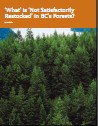
You might be interested in reading this small booklet by Ben Parfitt as well
|
|
Timely decisions about restocking BC forests for future timber supply needed
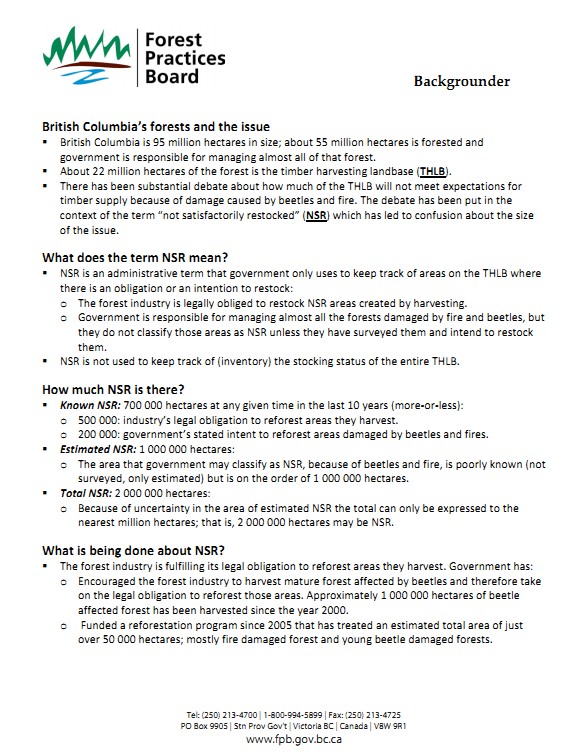
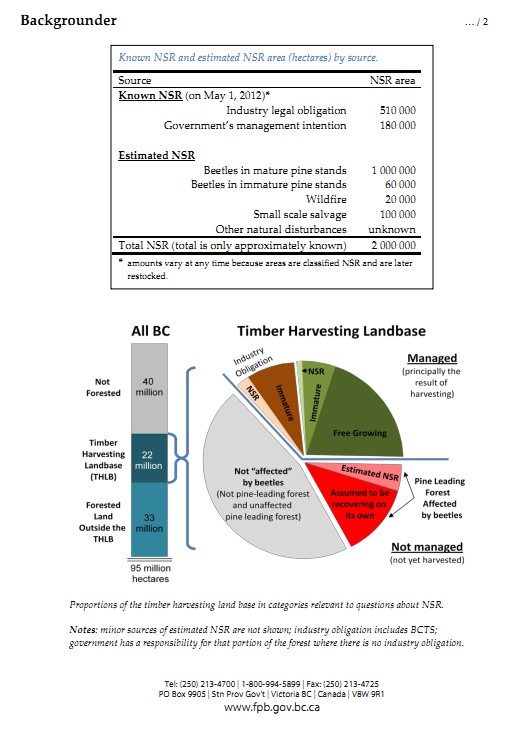
The report indicates that almost two million hectares of Crown forested land could potentially be “not satisfactorily restocked” (NSR). Of that, nearly half a million hectares will be restocked by industry and government has current plans to restock about a quarter of a million hectares. “Decisions about whether to replant areas where mountain pine beetle and fire have killed most of the trees will have an impact on the future timber supply in the BC interior,” said Al Gorley, board chair. “At a minimum, if nature is left to take its course, the eventual crop of timber in those areas will be delayed.” Government has a reforestation program for these areas, but to date it has only directed limited effort at re-stocking mature, beetle-affected forests because those areas might still be harvested – and eventually restocked – by the forest industry. “There is a lot of debate about exactly how much forest has been damaged by fire and beetles,” said Gorley. “But the important question is, should we invest money now to ensure a healthy timber supply into the future, and, if so, how will we raise and invest it? But if action is to be taken, it must be taken quickly.” The Board has made recommendations to government that it hopes will promote a useful dialogue on the topic of restocking British Columbia’s forests. The Forest Practices Board is B.C.’s independent watchdog for sound forest and range practices, reporting its findings and recommendations directly to the public and government. The board can investigate and report on current forestry and range issues and make recommendations for improvement to practices and legislation. |
|
NEWS!!!
July 2013: Some thoughts about the current situation, by Anthony Britneff
In this year's budget debate for the Ministry of Forests, Lands and Natural Resources Operations (MFLNRO), the loyal Opposition posed some really interesting questions on topics that really matter to British Columbians; topics such as wildfire protection surrounding communities; TFL tenure; industrial water usage and fees (e.g., for fracking) and sustainability of forest management especially with respect to forests, animals and habitat.
As a registered professional forester (retired), I find many of the Minister's answers to questions from the loyal Opposition to be weak failing to inspire confidence in how the government is managing our publicly owned natural resources. In particular, it appears that the government is failing to charge enough money in fees and rents for natural resources, which means it is not asserting the financial interests of the public because it is essentially giving away the natural resources.
Without sufficient revenue, the government is failing to invest in the land and chooses to see stewardship activities like tree planting and inventory as expenses that can be cut instead of as necessary investments that must be maintained in order to generate future revenues to fund education, health and other social programs. This year the government cut the MFLNRO budget by $40 million targeting forest stewardship with $35 million or 88 per cent of the cut.
For example, before 2000 the forests ministry spent more on tree planting alone than it does today on all these stewardship activities combined: tree planting; inventory; silviculture; research; tree improvement and genetics; monitoring and treatment of insects and disease; fresh water management; timber supply analysis and AAC determination; watershed restoration; fish, wildlife and habitat management; land-use planning; visual quality management; and climate change.
This fact alone should be enough to outrage every British Columbian concerned about the economy, job security and a secure future for our children. Given the global pressures of an unstable financial system and climate change, British Columbia's long-term economic security will depend on how well it cares for its renewable natural resources today because they, not the non-renewable resources, have the potential to provide for economic resiliency in an unstable global economy.
For your information, I am attaching web links to the complete Estimates Debate for the forest ministry and I strongly recommend you peruse the questions and answers:
DAY 1
Monday afternoon starting 1440 at:
http://www.leg.bc.ca/hansard/40th1st/20130708pm-House-Blues.htm
DAY 2
Tuesday morning starting 1005 at:
http://www.leg.bc.ca/hansard/40th1st/20130709am-House-Blues.htm
Tuesday afternoon starting 1425 at:
http://www.leg.bc.ca/hansard/40th1st/20130709pm-House-Blues.htm
****
About the author:
Anthony Britneff, retired after 39 years of public service with the B.C. Forest Service is still worrying about British Columbia’s forests and is therefore a valiant champion of the sustainable management of forests of his homeland.
Anthony Britneff, retired after 39 years of public service with the B.C. Forest Service is still worrying about British Columbia’s forests and is therefore a valiant champion of the sustainable management of forests of his homeland.
British Columbia Auditor General John Doyle has released his latest report, An Audit of the Ministry of Forests, Lands and Natural Resource Operations’ Management of Timber.
Nearly two-thirds of British Columbia’s 95 million hectares is forested. These forests contribute to employment, tourism and recreational opportunities, as well as generate significant revenue for government to finance public services. However, trends indicate that the future availability of timber will be smaller and less diverse, putting future revenue opportunities at risk. Stewardship responsibility for these forest resources lies with the Ministry of Forests, Lands and Natural Resource Operations.
Confidential report warns pine beetle set to destroy B.C. forestry jobsThe full, devastating impact of the pine-beetle epidemic that has swept across British Columbia will be felt in the next few years when up to half the forest-industry jobs in the province’s interior will vanish, according to a government report meant to be confidential. You can download the report here (other sources of the report: The Globe and Mail, internal) The document, a briefing report for the provincial Forests minister, was inadvertently posted on the internet. It gives details on the unfolding timber supply crisis that threatens “the short and medium-term sustainability” of communities that have depended on logging for generations.
The Government of British Columbia: Mid-Term Timber Supply ProjectAugust 15, 2012: October 2012:Letter from Steve Thomson, BC’s Minister of Forests, Lands and Natural Resource Operations regarding timber supply action planTwo answer letters: One from Dr. Fred Bunnell, a world renowned conservation biologist: http://www.vancouversun.com/news/Provincial+timber+policy+lacks+relevant+data/7386407/story.html
And this one from Ed Mankelow: http://www.timescolonist.com/Logging+growth+step+backward/7386190/story.html Ed Mankelow has been involved in B.C. parks protection and establishment since 1961. He was the chair for many years of the B.C. Wildlife Federation’s parks committee and past chair of the Canadian Wildlife Federation’s parks committee. His role has always been to protect the parks and wilderness. Both writers are responding to the government's response to the report of the Special Committee on Timber Supply -- here is the link: www.gov.bc.ca/pinebeetle
Anthony Britneff gave an interview to discuss overcutting issues in BC: The BC government says it is opening the door to the idea of logging old-growth forests to help boost timber supply. Forests Minister Steve Thomson insists any decision to cut would be based on science and would only be done if consensus was reached from all members of the community. As many as eight sawmills face closure as the timber supply grows thin. Examining the old-growth potential in central BC is just one of several actions the province plans to take.
January/February 2013:Ben Parfitt: Sneaky Liberals are planning a B.C. forest giveaway Given the short duration of the upcoming legislative session and the provincial election to follow, a government plan to introduce a scant two-paragraph bill granting it powers to fundamentally alter the course of forestry in B.C. is disturbing, to say the least. According to several sources who have been briefed on the legislation, the bill would give the provincial cabinet powers to grant forest companies de facto private control over public forestlands without first having to notify or consult with the public. Instead of companies enjoying rights to log set volumes of trees on public forestlands, companies would gain dramatically expanded powers to log trees on defined areas that in effect become their own semi-private fiefdoms. The bill follows a year in which the government has faced mounting criticism over a forest-health crisis due to decades of over-cutting and an unprecedented mountain pine beetle attack. Numerous sawmills now face closure, with all the hardships that portends for many rural communities. It also follows the losses of sawmills in Burns Lake and Prince George due to explosions and ensuing fires. In the wake of those events, various government documents were leaked indicating that the provincial government was revisiting a controversial “rollover” idea first pursued 25 years ago. At that time it met with such a groundswell of political and public opposition that the initiative was scuttled. Then-provincial forest critic and MLA for Prince Rupert, Dan Miller, called it “privatization on a massive scale” and warned: “Never before in the history of the province has this kind of giveaway been contemplated.” --------------------- MInister Steve Thomson: Nothing sneaky here I'm writing in response to Ben Parfitt's speculative and misleading Jan. 27 op-ed about upcoming proposed forestry legislation. Here are the facts: On Aug. 15, the bipartisan committee on timber supply released its unanimous report after visiting 15 communities and reviewing over 650 submissions. One of its recommendations was to enable the conversion of volume-based forest licences to area-based forest licences. On Oct. 9, I released Beyond the Beetle: A Mid-Term Timber Supply Action Plan - the government's response to the report, which contains the commitment to introduce legislation and states, "one requirement for any proposed conversion will be ensuring that the public interest is addressed, through the support of the local community, First Nations, stakeholders and the public." To reiterate: a public commitment in response to a public report, with public consultation needed before implementation - certainly not sneaky in my books. Steve Thomson, minister of Forests, Lands and Natural Resources -------------------- In response to Ben Parfitt’s op-ed about the B.C. Liberals’ intention to introduce legislation to rollover replaceable volume-based timber licenses to area-based tenures, the forests minister claims as a “fact” that the legislation stems from a recommendation from the special committee on timber supply that toured B.C. last summer. That is pure fiction. According to a leaked cabinet document, the “rollover” of volume-based licenses to area-based tenures was recommended to cabinet in April as an option to enable the rebuilding of the Burns Lake sawmill — a month before the committee was formed and five months before it made its recommendations public. The committee did not “in fact” recommend the conversion of volume-based licenses to area-based tenures. Rather, it gave significant and thoughtful cautionary recommendations “if conversion to more area-based tenures is desirable.” The committee found there is still no consensus on the relative merits of area-based tenures and significant concern about the potential privatization of our largest public asset. The minister also gave Hampton Affiliates a “letter of intent” in September committing to the conversion of this U.S. company’s volume licenses to area-based tenures — a full month before he publicly released a response to the committee’s recommendations. The fact is: the Liberals were on the rollover path long before any public process. Enabling legislation will not guarantee in law any defined public process in the rollover decisions. It is used to give politicians “flexibility” to take actions without the constraints of law or guiding regulations. Used inappropriately, it can be a very “sneaky” instrument indeed. We must oppose giving politicians the unfettered right to radically alter forest tenures or to privatize our public forests. I certainly intend to do that in this upcoming session. It would be nice to know if the NDP will join me in this fight. Bob Simpson, MLA, Cariboo North -------- Prove me wrong Forests Minister Steve Thomson takes issue with the “highly speculative” nature of my recent op-ed in which I suggest that the provincial government intends to grant cabinet open-ended powers to give forest companies de facto control of public forestlands. He does not quibble with the fact that legislation is, in fact, coming, but says that government will be open and accountable by “ensuring” that the public is consulted. But will public consultation be enshrined in law? That’s the question. If Mr. Thomson wishes to end speculation that the interests of First Nations, communities and other stakeholders could be circumvented in the upcoming bill, he should simply publish the contemplated legislation. I would consider it a public service and a small price to pay to be proven wrong. Ben Parfitt, Canadian Centre for Policy Alternatives
|
You may draw your attention to this site as well: Healty forests and healthy communities - A conversation on BC Forests
British Columbia's dispute on Sustainable Forest Managment (SFM)
Ben Parfitt: Sneaky Liberals are planning a B.C. forest giveaway
Forests minister launches boost for timber industry at Victoria convention
In a bid to spur timber harvesting on the coast, the provincial government announced it will look at new technology for scaling logs, fast-track the auction of an additional 500,000 cubic metre of timber and make improvements to the log-export system. The initiatives were unveiled by Forests...
Steps taken to improve coastal forest economy
To increase harvesting activity on the coast, government is exploring the use of new scanner technology for scaling logs, accelerating the auction of an additional 500,000 cubic metres by BC Timber Sales, improving the log-export system and exploring ways to better harvest the timber profile....
Letter from Steve Thomson, BC’s Minister of Forests, Lands and Natural Resource Operations regarding timber supply action plan
With the release of ‘Beyond the Beetle: A Mid-Term Timber Supply Action Plan’, we have outlined a clear strategy to help our forests recover from the damage done by the mountain pine beetle infestation. Unfortunately the release of the action plan has led to the spread of misinformation and it’s...
Long-term plan needed for B.C.'s forests
Re: "Manage forests for the future," Oct. 17. The editorial is spot-on in many respects. What it omits is that presentations to the Special Committee on Timber Supply did not support the unsustainable logging of old-growth reserve forests, of sensitive areas and of marginally economic forests at...
Wisconsin tribe has much to teach us
Re: "Manage forests for the future," Oct. 17. The editorial correctly observes that B.C.'s public forests must be managed for the future. The Menominee native Americans in Wisconsin are an excellent example of people doing this. In 1854, they were confined to their current reservation of 235,000...
Manage forests for the future
As it looks for ways to shore up the province's timber industry, the B.C. government is in danger of not seeing the forest for the trees. The harvesting of pine beetle-damaged logs is winding down, and now lumber mills in the Interior face a shortage of logs. The government, as it should, is...
More logging won't cure trade's ills
The B.C. Liberal government stirred up controversy recently by proposing to remove scenic forest protections in the Harrison, Chehalis and Stave Lakes regions near Vancouver. Their "quick-fix" attempt to provide more timber for logging fails to recognize that the coastal forest industry's 20-year...
Committee recommends measures to increase timber supply
VICTORIA –The Special Committee on Timber Supply today released its unanimous report making 22 recommendations to increase the supply and value of mid-term timber and to strengthen future forest management in the B.C. Central Interior. This region of the province has been hit hard by the current...
MLAs aren't facing the truth: B.C. forests are tapped out
Since May, when a special committee of the legislature was appointed to address a looming "timber supply" crisis, questions have arisen about what the committee would say about one community in particular. That community is Burns Lake, where an explosion and fire in January levelled the local...
MLAs Blow Chance to Help Us See BC's Next Forest Industry
The Special Legislative Committee on Timber Supply has completed their report intended to help the forest sector and communities impacted by the Mountain Pine Beetle and more specifically address the issues related to possible re-building the Burns Lake sawmill destroyed by fire in January. The...
Forests need help
The unanimous decision of the special committee on timber sup-ply to support an increase of logging in "marginally economic forests" and in old-growth reserves previously ruled off limits to logging is outrageous. If acted upon, the committee's recommendations will worsen the current ecological...
B.C. Timber Supply committee releases report with recommendations to increase timber supply
The Special Committee on Timber Supply today released its unanimous report making 22 recommendations to increase the supply and value of mid-term timber and to strengthen future forest management in the B.C. Central Interior. This region of the province has been hit hard by the current mountain...
Opinion-Editorial from British Columbia’s Minister of Forests, Lands and Natural Resource Operations
Ensuring a sustainable timber supply, with the right mix of tree species, is a top priority for the Ministry of Forests, Lands and Natural Resource Operations. British Columbia is world-renowned for its sustainable forest management. More than 53 million hectares of land are certified to one of...
PPWC takes stance against BC’s proposal to log protected areas
The Pulp, Paper and Woodworkers of Canada (PPWC) union has come out against British Columbia’s proposal to open up protected areas to logging. “It’s just short term gain for probably long term pain,” said Arnold Bercov, the forest resource officer for the Pulp, Paper and Woodworkers of Canada,...
B.C. Forest Minister reappoints 4 Forest Practices Board members
British Columbia Forests, Lands and Natural Resource Operations Minister Steve Thomson has announced the reappointment of four board members to the Forest Practices Board for terms of two years each. The appointees are:
British Columbia’s Special Committee on Timber Supply consultation schedule
The British Columbia Special Committee on Timber Supply has announced its plans for conducting community and provincial consultations. The all-party committee was appointed in May 2012 to investigate and make recommendations to address the loss of mid-term timber supply in the central interior due...
New committee formed in British Columbia to examine mid-term timber supply
British Columbia’s Forests, Lands and Natural Resource Operations Minister Steve Thomson applauded today’s decision of the Legislative Assembly to form a Special Committee on Timber Supply to examine and make recommendations about mid-term timber supply in British Columbia, as a result of the...
Leaked Cabinet document reveals how far government was willing to go
When I was home during the Easter break I caught wind that the government was contemplating a “Burns Lake Recovery Act,” legislation designed to guarantee a log supply for Burns Lake to ensure Hampton Affiliates would rebuild the mill that burned down in January. Industry representatives told me...
Province considers 'option' of over-riding chief forester to supply mills with timber
A leaked Ministry of Forests document reveals a proposal that the B.C. government override the top official charged with managing the province's forests to find a timber supply for Burns Lake. The forestry-dependent town west of Prince George lost its main employer in a December fire that destroyed...
Canada, External News, Kanada, Nachhaltige Forstwirtschaft, Nachhaltige Waldwirtschaft, Sägeindustrie, SFM, Sustainable forest management, Papier- und Zellstoffindustrie, Forest products, Plattenindustrie, British Columbia's public dispute on Forests, Woodworking industry, Saw milling industry, Pulp- and Paperindustry, Panel Industry, Boardindustry